
EPF Notification towards Rate of Interest declared for FY 2021-22 @ 8.10%, interest amount may reflect in individual accounts soon
While giving rationale behind the interest rate cut, Union Finance Minister Nirmala Sitharaman had said the proposal to cut interest rate paid on employees’ provident fund deposits was dictated by today’s realities where returns on other small saving instruments were even lower.
(With inputs from IANS)
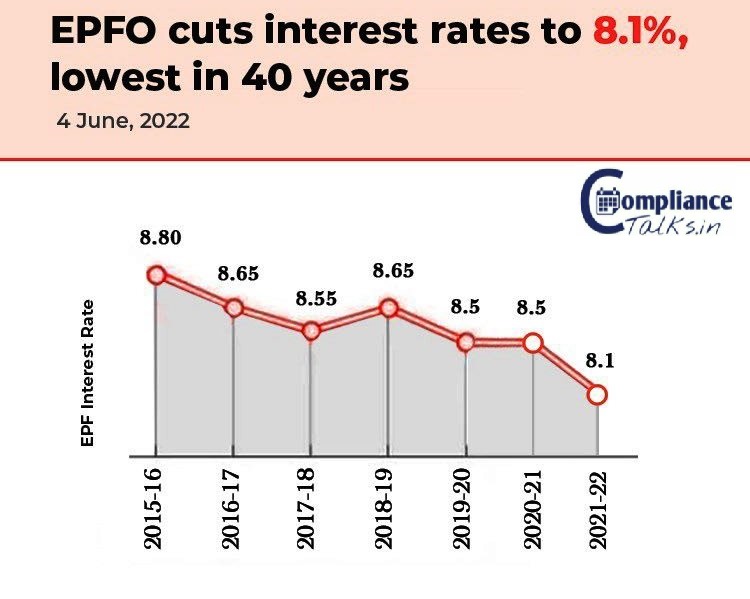
The Union government on Friday approved reducing the interest rate on employees’ provident fund deposits from 8.5% to 8.1% for 2021-’22, PTI reported.
The Employees’ Provident Fund Organisation, or EPFO, issued a notification stating that the Union Ministry of Labour and Employment has conveyed the Centre’s approval for the interest rate.
The EPFO is a government body that manages the country’s largest retirement fund with nearly 6 crore active subscribers.
Provident fund accounts are mandatory for workers earning up to Rs 15,000 a month in companies with more than 20 employees. At least 12% of an employee’s basic salary is compulsorily deducted to be deposited in the provident fund, while the employer also contributes the same amount.
The new rate of interest on provident fund deposits is the lowest since 1977-’78, when it was 8%. EPFO’s Central Board of Trustees had proposed lowering the interest rate on March 12.
The Central Board of Trustees is a tripartite body, headed by the labour minister and comprises representatives from the government, trade unions and employers.
On March 12, Congress spokesperson Randeep Surjewala had asked if reducing the provident fund interest rate was the ruling Bharatiya Janata Party’s “return gift” after winning elections in four states. In the Assembly election results declared on March 10, the BJP had won in the states of Uttar Pradesh, Uttarakhand, Manipur and Goa.
Surjewala claimed that the income of 84% of the country’s population has decreased. “Is it right to attack the savings of crores of employees on the basis of electoral victory?” he asked.
However, Labour Minister Bhupender Yadav had said at the time that international conditions as well the stability of markets had to be considered while taking the decision. “We cannot take high risk instruments as we have to keep social security and market stability in mind,” he had said.
Notification :
 Loading…

 Reload document
  Open in new tab